Car tax used to be simple: buy the car, pay the flat rate, move on.
Not anymore.
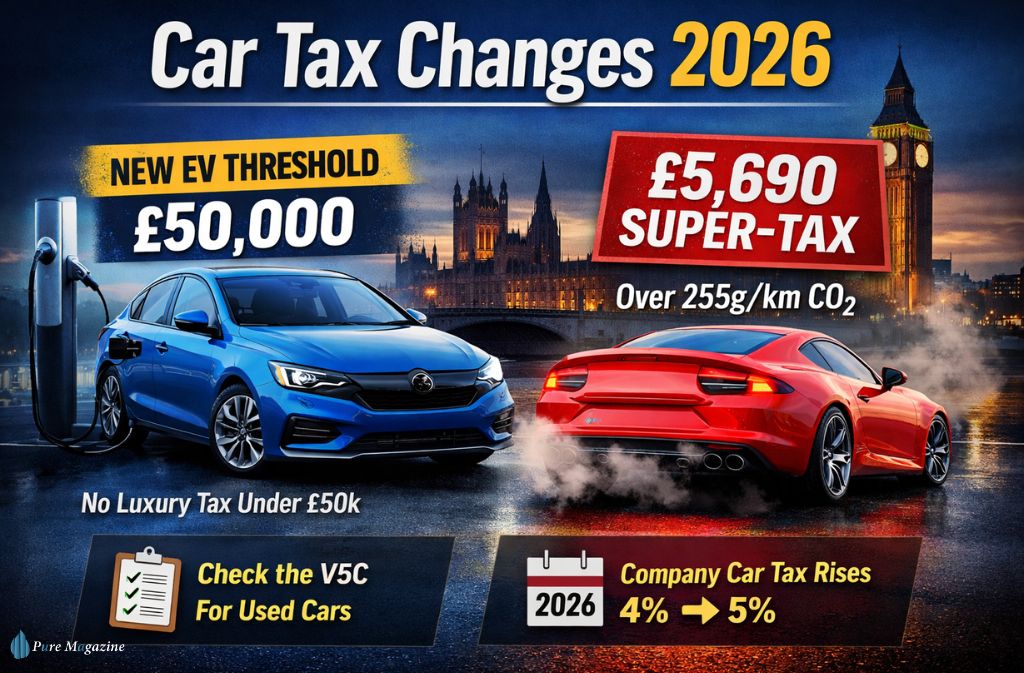
The car tax changes 2026 reshape who pays the luxury supplement, introduce a £5,690 first-year shock for high-emission cars, and quietly raise company car tax again. Meanwhile, EV buyers get one important break — but only if they understand the registration rules.
If you’re here, you’re probably asking: how much will my road tax be in 2026? Does the £40,000 rule still apply? Are EVs really taxed now?
Let’s break it down clearly — with real numbers, examples, and the traps that cost drivers thousands.
Vehicle Excise Duty (VED) policy is set by HM Treasury under Chancellor Rachel Reeves and administered by HM Revenue & Customs and the Driver and Vehicle Licensing Agency.
TL;DR: Car Tax 2026 in 60 Seconds
- Standard annual rate: ~£190
- EV first-year rate: £10
- EV luxury threshold (from April 2026): £50,000
- Petrol/diesel luxury threshold: £40,000
- Luxury supplement: ~£425 per year (years 2–6)
- Top first-year rate (255g/km+): £5,690
- EV company car BiK: 4% in 2026 → 5% in 2027 → 6% in 2028
Now let’s go deeper.
The Big Shift: EV Luxury Threshold Raised to £50,000
From 1 April 2026, electric vehicles only pay the Expensive Car Supplement if their list price exceeds £50,000. Petrol, diesel, and hybrids remain at £40,000.
As confirmed in GOV.UK’s official VED Expensive Car Supplement threshold increase publication, zero-emission cars with a list price which exceeds £40,000 but does not exceed £50,000 will no longer be required to pay the ECS charge when they take out a licence which comes into effect on or after 1 April 2026. The threshold remains at £40,000 for all other cars.
2026 Expensive Car Supplement Comparison
| Vehicle Type | Price Threshold | Annual Supplement (Years 2–6) |
|---|---|---|
| Petrol / Diesel | £40,000 | ~£425 |
| Hybrid (PHEV) | £40,000 | ~£425 |
| Electric (EV) | £50,000 | ~£425 |
That’s a meaningful policy pivot.
2026 vs 2024: Real Example (Hyundai IONIQ 5)
Let’s use a popular model — the Hyundai IONIQ 5. Approximate list price: ~£43,000.
Bought in 2024: EV threshold was £40,000, luxury supplement triggered, £425 × 5 years = £2,125 extra.
Bought in 2026: EV threshold now £50,000, no supplement, savings: £2,125 over five years.
Same car. Same price. Different tax treatment. That’s why registration date matters more than ever.
The £5,690 “Super-Tax” for High-Emission Cars
For vehicles emitting over 255g/km of CO₂, the first-year VED in 2026 is £5,690. This applies mainly to performance petrol cars, large SUVs, and high-capacity engines.
After year one: standard rate (~£190) applies, plus luxury supplement if over threshold.
It’s designed as a deterrent — not an ongoing penalty — but the upfront hit is substantial. As confirmed by the Office for Budget Responsibility’s VED analysis, first-year rates are determined using CO₂ figures measured under the WLTP test procedure — the band your car falls into at the point of manufacture determines the first-year charge permanently, regardless of any subsequent rate changes.
🚨 Stop: The “Discount Myth” That Costs Drivers £2,000+
Before negotiating, read this.
A £2,000 dealer discount does NOT remove the luxury tax. The DVLA uses Manufacturer’s Recommended Retail Price (MRRP) plus factory-fitted options at first registration — not what you paid.
Example: Sticker price: £40,001. Your negotiated price: £35,000. You still owe £425 per year for five years. Total ≈ £2,125.
Even optional extras like metallic paint can push you over the threshold. Always ask for the official list price, including options. Understanding how to check your current road tax status via the DVLA vehicle enquiry service helps you verify what the system holds for any vehicle before you commit to a purchase.
Strengthened Used Car Warning (The V5C Secret)
This is where many drivers get caught. If a car was registered between April 2017 and March 2025, the £40,000 threshold is permanently “baked in” — even if you buy it in 2026.
The V5C Secret
Don’t rely on the dealer’s memory. Check the V5C logbook: registration date, CO₂ emissions, and original price status.
If you buy a second-hand EV over £40k registered in 2024, you’re paying that luxury supplement until 2029. The new £50k rule does not apply retrospectively.
The “Modern Classic” Squeeze (2001–2017 Cars)
Cars registered between 2001 and 2017 remain on the older emissions-band system. Those bands increase annually with inflation (RPI). That means some 2010 petrol cars now cost £300+ annually, while new hybrids pay £190 flat rate after year one.
Older doesn’t always mean cheaper.
Company Car Tax 2026–2028 (BiK Lookahead)
EV Benefit-in-Kind (BiK) is confirmed to rise gradually. As confirmed in GOV.UK’s official company car appropriate percentage publication, for the tax year 2026 to 2027, the appropriate percentage for zero-emission cars will be increased by a further 1 percentage point, rising to 4% — and then to 5% in 2027/28.
- 2026: 4%
- 2027: 5%
- 2028: 6%
Example: £45,000 EV company car, 4% in 2026 = £1,800 taxable benefit. Your personal tax depends on your income bracket. Understanding what income tax band you fall into determines whether that £1,800 taxable benefit costs you £360 (basic rate) or £720 (higher rate) in actual tax.
This three-year visibility adds planning certainty — but EV company car savings are narrowing gradually.
The 2028 Horizon: Indexation & Pay-Per-Mile
Here’s the strategic view. 2026 is the transition year. We’re moving from a system that taxes what you drive toward one that may tax how much you drive.
1️⃣ RPI Indexation
VED is subject to annual RPI indexation. That ~£190 standard rate increases each April. By 2028, that “£190” could easily be £210+ purely through inflation adjustments — before any structural reforms begin.
2️⃣ Pay-Per-Mile (PPM) Discussions
As confirmed by the GOV.UK VED rates policy documentation, the government has announced the introduction of eVED — a new mileage supplement for electric and plug-in hybrid cars from April 2028. Electric car drivers will pay 3p per mile and plug-in hybrid drivers 1.5p per mile, in addition to standard VED rates. The government has confirmed no tracking devices will be required, and mileage will likely be verified at MOT test centres.
No broader legislation yet for petrol and diesel vehicles. But a flat-rate tax may not be permanent.
If Pay-Per-Mile launches around 2028, high-mileage drivers could pay more, and low-mileage drivers may benefit. Think beyond the 2026 rate sheet.
2026 Car Tax Identification Checklist
Before buying, ask:
Is it Electric? → Over £50,000? Yes → Supplement applies / No → Standard rate
Is it Petrol/Diesel? → Over £40,000? Yes → Supplement applies / No → Standard rate
Registered Before April 2017? → Yes → Check CO₂ Band G–M / No → Flat rate after year one
Five minutes of checking can prevent a five-year mistake. You can verify any vehicle’s registration date and tax status instantly using the DVLA’s free vehicle enquiry service.
Common 2026 Mistakes
- Thinking EVs are still tax-free
- Confusing purchase price with list price
- Ignoring the V5C registration date
- Forgetting the five-year supplement duration
- Overlooking annual indexation increases
Drivers who want to cancel car tax when selling or declaring SORN should do so immediately — the DVLA issues automatic refunds for full months remaining, but only from the date cancellation is processed, not the date you stopped driving.
FAQs
Q. How much will my road tax be in 2026?
Most cars pay around £190 annually after year one. High-emission cars (255g/km+) pay £5,690 in the first year. As confirmed by GOV.UK’s official VED rates documentation, rates are uprated annually in line with RPI to maintain receipts in real terms.
Q. What is the £50,000 EV tax rule?
From April 2026, electric vehicles only pay the luxury supplement if their list price exceeds £50,000, as confirmed in the GOV.UK ECS threshold increase publication.
Q. Does a dealer discount affect the 40k car tax rule?
No. The DVLA uses the original manufacturer list price including options — not your negotiated price.
Q. Are used EVs affected by the new £50k threshold?
Only if first registered from April 2026 onward. Earlier registrations stay under the £40k rule.
Q. Will road tax increase again in 2027?
Yes. VED is indexed to inflation (RPI) and typically rises each April. The DVLA vehicle tax checker always reflects the current applicable rate for any registered vehicle.
Conclusion
The car tax changes 2026 aren’t random hikes — they’re structural adjustments.
Remember: EV luxury threshold rises to £50,000, high emitters face £5,690 first-year tax, used car rules don’t change retrospectively, BiK rises to 6% by 2028, and standard rate will creep upward via indexation.
Before signing any agreement, check the registration date, list price, and emissions band. A small detail today could mean £2,000+ difference over five years. Use the DVLA vehicle tax checker to confirm any vehicle’s current tax status before purchase.
Stay informed, stay compliant, and stay ahead — Pure Magazine covers the UK tax and finance topics that actually matter to real people in 2026.