Small technology-driven businesses are no longer limited to software startups or digital platforms. Today, many small and mid-sized enterprises operate hybrid models—combining automation equipment, digital fabrication tools, laboratory-grade instrumentation, and precision heating systems to deliver specialized products or services. In these environments, operational efficiency depends not only on software architecture but also on the physical materials integrated into core hardware systems.
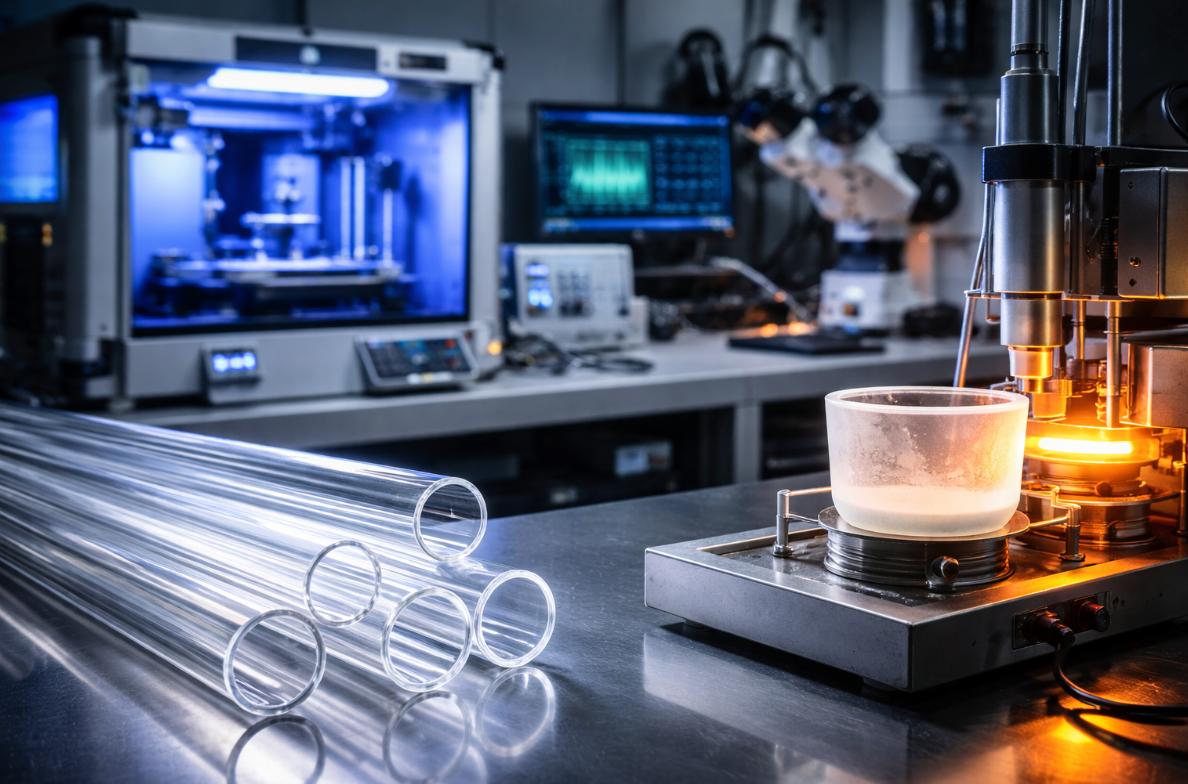
As automation becomes more accessible, even smaller manufacturers and engineering-led startups are investing in compact UV curing units, infrared heating assemblies, optical inspection tools, and benchtop process equipment. In these systems, material stability, thermal consistency, and optical performance directly influence reliability. Increasingly, companies are integrating high-transparency fused silica tubing integrated into precision automation platforms to ensure consistent light transmission and dimensional stability in compact industrial setups.
This shift reflects a broader trend: advanced materials are no longer exclusive to large-scale industrial operations. Instead, they are becoming foundational components in agile, tech-enabled small businesses seeking higher throughput, reduced downtime, and predictable system performance.
1. From Cost Minimization to Performance Optimization
Historically, small businesses prioritized upfront equipment cost. However, as competition intensifies and margins tighten, operational predictability has become more valuable than initial savings.
In UV-based curing, sterilization, or inspection systems, material transparency and thermal resilience are critical. Fused silica, commonly referred to as high-purity quartz glass, offers:
- Excellent UV transmission (especially in the UV-C range around 254 nm)
- Low coefficient of thermal expansion (~0.5 ×10⁻⁶ /K)
- High softening temperature (~1665°C)
- Resistance to thermal shock compared to borosilicate glass
| Property | Fused Silica | Borosilicate Glass |
| UV Transmission at 254 nm | >90% | <20% |
| Coefficient of Thermal Expansion | ~0.5 ×10⁻⁶ /K | ~3.3 ×10⁻⁶ /K |
| Softening Point | ~1665°C | ~820°C |
Data compiled from standard optical and materials engineering references (ASM Handbook, SPIE data tables).
For small businesses operating compact UV reactors or IR heating tools, these properties translate into:
- Fewer replacements
- Lower risk of thermal cracking
- Stable optical output over time
The financial implication is clear: predictable performance reduces maintenance variability and protects service-level commitments.
2. Automation Demands Material Precision
Modern small enterprises increasingly deploy:
- Desktop manufacturing systems
- Automated thermal batch units
- UV exposure chambers
- Optical measurement equipment
Automation introduces repeatability—but only if the materials inside the system maintain dimensional integrity.
In thermal batch operations, quartz crucibles often serve as controlled containment environments for high-temperature processing. Businesses that scale through precision batch production increasingly rely on engineered quartz crucible assemblies optimized for controlled thermal batch operations to maintain uniform heating conditions and minimize contamination.
Dimensional consistency in these components reduces:
- Uneven thermal distribution
- Stress-induced cracking
- Contamination from reactive materials
When operating in high-temperature environments (800–1200°C or higher depending on process), crucible geometry, surface finish, and impurity levels can directly affect batch repeatability.
For a small business offering specialty material treatment or analytical services, even minor batch variation can compromise credibility. Advanced materials help maintain uniform process outcomes.
3. Optical Stability Enables Data Accuracy
Tech-driven small businesses often incorporate optical sensing, laser alignment, or spectroscopic analysis into their workflows. In such systems, quartz components may function as:
- Optical windows
- Protective enclosures
- UV transmission sleeves
- Light guides
Optical distortion or surface degradation introduces measurement error.
Fused silica is valued in photonic and analytical systems due to:
- Broad transmission range (deep UV to near-infrared)
- Low refractive index variability
- High resistance to solarization under UV exposure
For small labs and fabrication startups, this means:
- Reliable calibration
- Consistent sensor feedback
- Stable light energy delivery
Material selection therefore becomes part of the digital accuracy chain—not just a structural choice.
4. Reducing Maintenance Interruptions Through Thermal Compatibility
Small businesses often operate in constrained physical environments where space-saving equipment integrates quartz components with stainless steel housings, aluminum frames, and ceramic fixtures.
Thermal compatibility between materials is essential.
When metals with high expansion coefficients constrain quartz components, stress concentrations develop at mounting points. Over repeated heating cycles, this can cause:
- Microfractures
- Seal failure
- Sudden breakage
Fused silica’s extremely low expansion reduces stress under constrained assembly conditions. Combined with proper tolerance control and annealing processes, this minimizes unexpected failure in compact automation platforms.
Downtime in small operations can be disproportionately disruptive. A single equipment failure may halt production entirely, unlike large factories with redundancy. Material stability therefore plays a strategic role in business continuity.
5. Scalability Without Infrastructure Expansion
One advantage of tech-enabled small businesses is scalable precision rather than physical expansion.
By integrating durable quartz components:
- UV systems maintain consistent output intensity
- Heating chambers sustain stable thermal cycles
- Optical modules retain calibration accuracy
This allows companies to:
- Increase production cycles per day
- Reduce recalibration frequency
- Extend service intervals
Instead of investing in new infrastructure, they optimize the performance of existing systems through improved material integration.
Advanced materials thus act as silent scalability enablers.
Engineering Constraints Small Businesses Must Consider
When integrating quartz components into compact automation systems, key engineering variables include:
- Wall thickness uniformity
- Surface finish quality
- Thermal annealing history
- Hydroxyl (OH) content for UV applications
- Dimensional tolerances (OD/ID control)
Failure to control these factors can lead to:
- Devitrification under prolonged heat
- Reduced UV transmission
- Mechanical stress fractures
Engineering-focused procurement decisions help mitigate these risks.
Conclusion: Material Strategy Is Now a Competitive Strategy
Advanced materials are no longer reserved for multinational industrial giants. As automation, UV processing, and precision thermal systems become accessible to smaller enterprises, material performance increasingly defines operational resilience.
For tech-driven small businesses, integrating stable fused silica tubing and engineered quartz crucibles into core systems offers:
- Improved thermal reliability
- Enhanced optical performance
- Reduced downtime risk
- Greater process repeatability
In a competitive environment where reputation depends on precision and consistency, advanced materials function not as optional upgrades—but as structural pillars of scalable, technology-enabled growth.
The future of small business operations is not only digital. It is material-driven.
For more, visit Pure Magazine