The Google Gnome Game Doodle appears simple: launch a garden gnome and watch it bounce across a playful landscape. In reality, the game operates on a surprisingly strict physics model. Small differences in launch angle, character choice, and terrain interaction can determine whether a run ends early in mud or stretches into four-digit territory.
Based on repeated testing and long-running community score tracking, the Google Gnome Game in 2026 behaves consistently enough to be treated as a skill-based physics game, not a random novelty. This guide documents how the physics system works, which character performs best, where to play the archived doodle today, and which advanced techniques (including the back-launch exploit) reliably increase scores.
TL;DR (Quick Answers)
- What the game is: A Google Doodle physics game where the distance traveled equals the score.
- Best gnome: The Pink Gnome (highest bounce-to-roll efficiency).
- One core trick: Release at ~85% power for a low arc; flat first bounces outperform high launches.
At a Glance: How to Master the Google Gnome Game (2026)
Best Character: Pink Gnome (highest bounce + roll potential)
Optimal Release: ~85% power (just before peak)
Core Principle: Flat first bounce → longer roll distance
Advanced Trick: Back-launch exploit to skip early mud zones
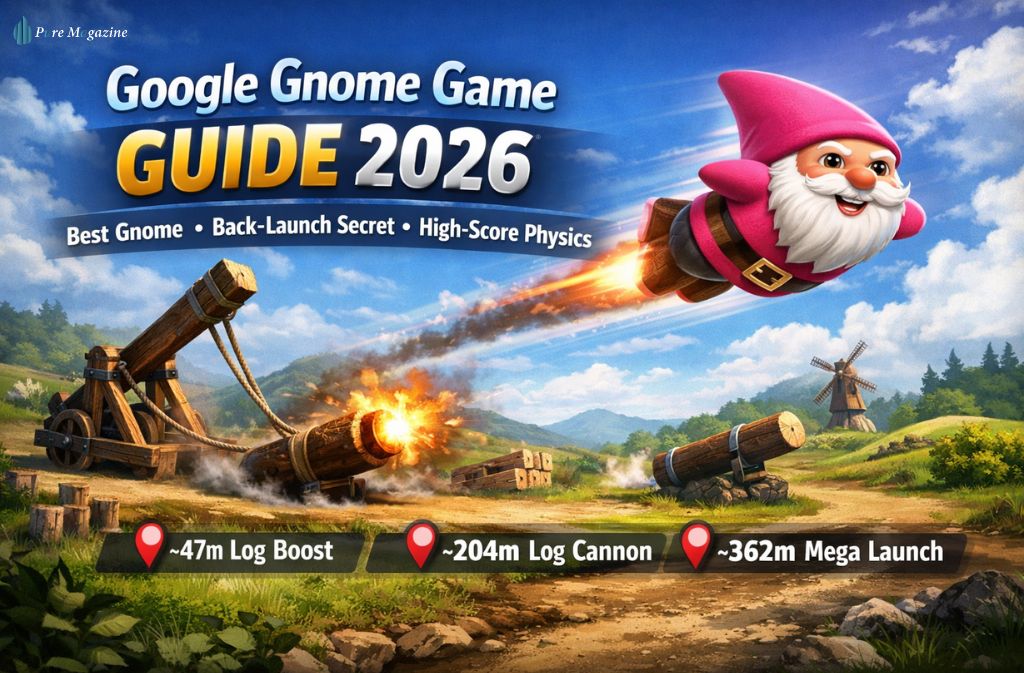
Score Boosts: Fixed log cannons at ~47m, ~204m, ~362m
What Is the Google Gnome Game Doodle?
The Google Gnome Game is an interactive Google Doodle mini-game originally released to celebrate garden gnomes. Players launch a gnome from a trebuchet and attempt to achieve the longest possible distance across variable terrain, including mud patches, logs, slopes, and bounce elements.
Why the game still draws traffic in 2026:
- Archived and replayable through Google’s doodle library
- Zero friction: no download, no account
- Simple controls with layered physics depth
- Ongoing community competition around high scores
Where Can You Play the Google Gnome Game in 2026?
The Google Gnome Game remains playable through the Google Doodle archive, which hosts interactive doodles long after their original release.
Availability notes:
- The archived doodle version works in modern browsers
- Some school or workplace networks block Google Doodles
- Third-party “unblocked” mirrors exist, but may be outdated or unstable
Best practice:
Use the official Google Doodle archive whenever possible for stability and correct physics behavior.
How to Play the Google Gnome Game (Step-by-Step)
- Open the archived Google Gnome Game doodle
- Click or tap to charge the trebuchet
- Release to launch the GNOME
- Observe how the gnome interacts with the terrain
- Distance traveled equals score
- Reset and refine launch timing
Controls:
- Desktop: Click and hold → release
- Mobile: Tap and hold → release
There is no mid-air control. Outcomes depend entirely on release timing, launch angle, and terrain physics.
Why the Google Gnome Game Physics Feel Random (But Aren’t)
The Google Gnome Game’s physics feel unpredictable because the terrain is procedurally varied. However, the underlying model is consistent. The same inputs produce similar outcomes across repeated runs.
Three mechanics control most outcomes:
| Factor | What It Controls | Optimization |
|---|---|---|
| Launch Angle | Airtime vs roll | Lower arcs convert better to roll |
| Initial Power | First bounce energy | ~85% power outperforms max power |
| Terrain Type | Friction and momentum | Flat and downhill preserve speed |
On paper, maximum power should win. In practice, it usually does not. Lower arcs convert more energy into sustained rolling, which produces longer distances over time.
If a run dies at ~198 meters—just short of the second log cannon—it demonstrates how unforgiving the physics model can feel when key boost points are missed.
Google Gnome Game Best Character (Character Stats Explained)
The Pink Gnome is the best character in the Google Gnome Game because it converts bounce energy into roll more efficiently than heavier characters.
Contrary to older assumptions, the gnomes are not purely cosmetic. Community testing indicates that each character has slightly different physics properties.
Character Stat Comparison (2026 Community Findings)
| Gnome | Weight | Bounce | Roll Efficiency | Best Use Case |
|---|---|---|---|---|
| Pink Gnome | Light | High | Excellent | Best overall for high scores |
| Slim Yellow | Very Light | Medium | High glide | Flat trajectories |
| Large Blue | Heavy | Low | Weak in mud | Stable on soft terrain |
| Large Red | Heavy | Low | Weak in mud | Performs better on rocky patches |
| Green | Medium | Medium | Balanced | Beginner-friendly |
| Classic | Medium | Medium | Average | No specific advantage |
Beginner Strategy (First 10 Runs)
Beginners benefit most from reducing complexity and focusing on one repeatable rule set.
Beginner framework:
- Select the Pink Gnome
- Release slightly before max power
- Reset runs where the first bounce lands uphill or in mud
- Focus on flat first bounces instead of high arcs
This approach builds consistency and quickly lifts average scores out of the low hundreds.
Also Check: How to Cancel Game Mopfell78 Fast (Simple Step-By-Step Guide)
Advanced Strategy (500+ Scores)
An Advanced play focuses on terrain exploitation and momentum stacking.
Advanced framework:
- Use the back-launch exploit to skip early mud zones
- Aim to trigger fixed log cannons at ~47m, ~204m, ~362m
- Prioritize downhill chains over single high bounces
- Reset aggressively when early boosts are missed
Is the Back-Launch Exploit Still Working in 2026?
Yes. The back-launch exploit still functions in the archived Google Gnome Game version as of 2026.
How the Back-Launch Works
If the trebuchet arm swings fully backward before release, the gnome launches behind the starting point. At approximately –28 to –30 meters, the gnome can collide with a hidden back log cannon that propels it forward with amplified momentum.
Why it works:
The backward zone uses older physics tuning that stacks velocity more aggressively than forward terrain. This interaction bypasses early mudfields and accelerates entry into high-multiplier zones.
Fixed Log Cannons (High-Score Boost Points)
There are three known fixed boost points in the Google Gnome Game:
| Boost Point | Distance | Strategic Value |
|---|---|---|
| Log Cannon #1 | ~47m | Preserves early momentum |
| Log Cannon #2 | ~204m | Escapes first major mudfield |
| Log Cannon #3 | ~362m | Enables extended downhill chains |
Missing the ~204m cannon significantly reduces the ceiling of most runs.
Why Physics Beats Luck in the Google Gnome Game
High scores are not the result of random, favorable terrain alone. They emerge from consistent exploitation of momentum transfer:
- Bounce-to-roll conversion: Lower arcs preserve horizontal velocity
- Momentum stacking: Sequential downhill bounces compound distance
- Friction management: Avoiding mud maintains roll speed
The terrain introduces variance, but the physics model remains stable. This allows the game to be mastered through repeatable technique rather than pure chance.
Common Mistakes That Reduce High Scores
- Holding for maximum power on every attempt
- Continuing runs with poor first bounces
- Overvaluing airtime instead of roll distance
- Ignoring fixed boost points
- Playing on devices with unstable frame rates
Run-Reset Rule:
If the first bounce lands uphill or in mud, resetting immediately produces better long-term averages.
Also Check: Games Unblocked 76: Safe Access Guide (2026)
Google Gnome Game High Score & World Record Context
There is no official leaderboard for the Google Gnome Game. Community-reported high scores vary due to terrain randomness and physics exploits. Scores should be treated as informal benchmarks rather than definitive records.
Google Gnome Game Unblocked, Archive & Availability
The Google Gnome Game archive remains accessible in 2026.
Some networks restrict Google Doodles. Third-party “unblocked” mirrors exist but may not preserve original physics behavior.
Strategy Cheat Sheet
- Use the Pink Gnome
- Release at ~85% power
- Favor low arcs
- Reset poor first bounces
- Trigger log cannons
- Apply back-launch for advanced runs
FAQs
Q. Where can the Google Gnome Game be played in 2026?
The Google Gnome Game can be played in 2026 through the official Google Doodle Archive, where the original interactive version remains accessible on desktop and mobile browsers.
Q. What is the best character in the Google Gnome Game?
The Pink Gnome is the best character for high scores because it has higher bounce efficiency and converts landing energy into forward roll more effectively than heavier gnomes.
Q. How can high scores be achieved in the Google Gnome Game?
High scores in the Google Gnome Game are achieved by using low-arc launches, selecting the Pink Gnome, and consistently triggering fixed boost points (log cannons) placed at specific distances along the terrain.
Q. Is the back-launch exploit still working in 2026?
Yes, the back-launch exploit still works in 2026 in the archived Google Doodle version, allowing players to launch backward into a hidden boost that propels the gnome forward with extreme momentum.
Q. Why does the Google Gnome Game bounce each run?
The Google Gnome Game bounces each run because the terrain layout changes slightly per attempt, while the underlying physics model remains consistent, causing variable outcomes based on landing angles and surface types.
Q. Does the Google Gnome Game rely more on luck or skill?
The Google Gnome Game relies more on physics-based skill than luck, as consistent high scores depend on mastering release timing, bounce-to-roll conversion, terrain reading, and boost-point positioning.
Conclusion
The Google Gnome Game rewards players who treat it as a physics system rather than a novelty. Character choice, release timing, and terrain interaction determine outcomes far more than chance. With consistent application of low-arc launches, strategic resets, fixed boost exploitation, and advanced techniques like the back-launch, high scores become repeatable rather than accidental.
Related: Vivid2201 Game Explained (2026): Performance, Patches & FPS