Software projects rarely fail because developers don’t know how to code. They fail because planning slips, quality problems surface too late, and teams discover—far too close to the deadline—that nobody has a clear picture of where the project actually stands.
That problem is exactly why the Team Software Process (TSP) exists.
The Team Software Process is a structured, data-driven framework designed to help software teams plan, track, and deliver high-quality software predictably. Instead of relying on intuition, heroics, or last-minute fixes, TSP turns teamwork into a disciplined, measurable system.
This guide explains:
- What the team software process is, in plain language
- How TSP works step by step
- The relationship between PSP and TSP
- How TSP compares with Agile approaches
- Where TSP still fits in modern (2026) software development
If you’re a student, developer, or project lead trying to make sense of software process models, this article is built to give you clarity—not theory overload.
What Is Team Software Process in Software Engineering?
Team Software Process (TSP) is a software engineering process framework developed by the Software Engineering Institute (SEI) to help development teams build high-quality software on schedule and within budget.
TSP focuses on how teams work—not on programming languages, tools, or architectures.
At a high level, TSP:
- Organizes developers into self-directed teams
- Assigns clear, rotating roles
- Uses measured data, not assumptions
- Emphasizes early defect prevention
- Makes progress visible throughout the project
Think of TSP as an operating system for a development team. It doesn’t write code for you—but it controls how work is planned, tracked, and improved.
The Relationship Between PSP and TSP (Simple Explanation)
TSP is built on top of the Personal Software Process (PSP).
| Aspect | PSP | TSP |
|---|---|---|
| Focus | Individual developer | Entire team |
| Scope | Personal planning and quality | Team coordination and delivery |
| Metrics | Time and defect data per person | Aggregated team metrics |
| Goal | Improve individual discipline | Deliver predictable team outcomes |
PSP trains individual developers to:
- Estimate their work
- Track time and defects
- Review quality systematically
TSP then brings those disciplined individuals together into a coordinated team process.
TSP is far less effective without the individual discipline established by PSP. Without reliable personal data, team-level planning quickly becomes guesswork again.
Objectives of the Team Software Process
TSP was designed to address recurring, real-world problems in software development.
Its main objectives are to:
- Deliver high-quality software
- Improve quality and productivity
- Reduce late-stage defect discovery
- Create realistic, data-backed schedules
- Increase team ownership and accountability
- Enable continuous process improvement
In short, TSP aims to reduce surprises—especially the expensive ones.
Also Check: Giglad Software Arranger Premium: Features, Setup & Honest Review (2026)
How the Team Software Process Works (Step by Step)
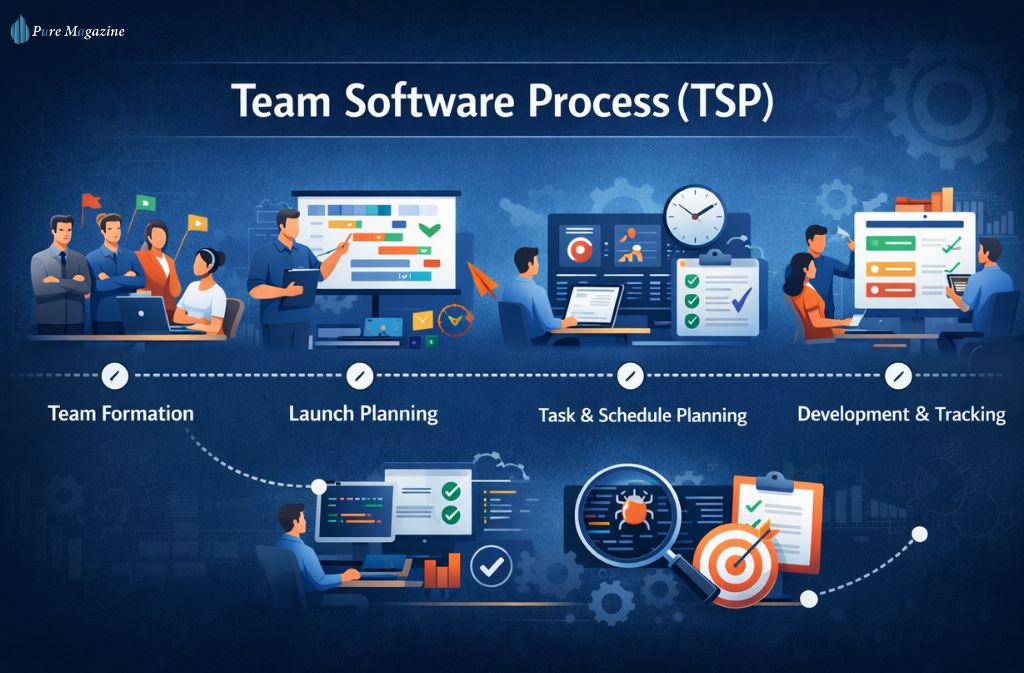
1. Team Formation and Role Assignment
Each team member takes on a defined role, such as:
- Team Leader
- Planning Manager
- Quality Manager
- Process Manager
- Support Manager
Roles rotate over time so responsibility and visibility are shared.
Clear roles prevent a common failure mode: everyone assuming someone else is handling it.
2. Launch Planning
At the start of the project, the team collectively defines:
- Project goals
- Scope and deliverables
- Task breakdowns
- Size and effort estimates
- Risks and quality targets
This is not top-down planning imposed by management. The team owns the plan—and the commitments.
3. Detailed Task and Schedule Planning
Work is decomposed into measurable tasks with:
- Time estimates
- Defect expectations
- Individual commitments
Estimates are grounded in historical data, not optimism.
This is where many teams discover their original assumptions were unrealistic—and adjust early.
4. Development and Tracking
During development:
- Time and defects are logged
- Weekly reviews track actual vs. planned progress
- Deviations are addressed while recovery is still possible
Tools change.
Frameworks evolve.
Team discipline is still the hard part.
5. Quality Management and Defect Prevention
TSP emphasizes:
- Design reviews
- Code inspections
- Early verification
Fixing defects early is often an order of magnitude cheaper than addressing them late in the lifecycle—a principle long emphasized by SEI research.
This isn’t about perfection. It’s about avoiding avoidable rework.
6. Postmortem and Process Improvement
After delivery, the team reviews:
- What worked
- What didn’t
- What should change next time
This feedback loop turns each project into input for the next.
This is where long-term improvement actually happens.
A Simple Real-World Example
Scenario:
A six-person student software team consistently misses deadlines and spends the final week fixing bugs.
Before TSP:
- No formal roles
- Guess-based estimates
- Testing is squeezed to the end
After applying TSP principles:
- Clear ownership for planning and quality
- Weekly tracking exposed schedule risk early
- Fewer late defects
- Delivery within ±5% of the original plan
The code didn’t magically improve.
The process did.
Team Software Process vs Agile (Important Clarification)
TSP is often misunderstood as being opposed to Agile methods. It isn’t.
| Aspect | TSP | Agile |
|---|---|---|
| Structure | Highly defined | Lightweight and adaptive |
| Planning | Data-driven upfront planning | Iterative planning |
| Metrics | Detailed measurement | Minimal necessary metrics |
| Best suited for | Predictability and quality | Speed and adaptability |
In practice, many teams use Agile practices for execution while borrowing TSP-style discipline for planning, estimation, and quality tracking.
TSP is not a replacement for Agile. It’s a compliment when predictability matters.
Common Mistakes Teams Make with TSP
- Treating TSP as paperwork rather than a working system
- Skipping PSP discipline and expecting TSP to compensate
- Collecting data but never using it
- Assigning roles without real authority
- Attempting partial or superficial adoption
Teams often resist TSP at first because it feels heavy—especially compared to lighter Agile rituals. In practice, that resistance usually fades once missed deadlines stop being “normal.”
Half-implementations tend to create more frustration than progress.
Also Read: The Best Hiring and ATS Software for 2026
Why Team Software Process Still Matters in 2026
Despite modern tooling and AI-assisted development:
- Software systems are more complex
- Distributed teams are the norm
- Quality failures are more costly than ever
Historically, TSP has been adopted most heavily in aerospace, defense, and other safety-critical software environments, where predictability matters more than rapid experimentation.
AI can help write code—but managing teamwork, trade-offs, and accountability is still very much a human problem.
Quick Cheat Sheet: Team Software Process
- Developed by: Software Engineering Institute (SEI)
- Built on: Personal Software Process (PSP)
- Primary goal: Predictable delivery of high-quality software
- Best suited for: Teams that value discipline and reliability
- Not a substitute for: Agile or technical development methods
Frequently Asked Questions
Q. What is an example of a team software process?
An example of a team software process (TSP) is a software development team that assigns formal roles (such as team leader and quality manager), creates a shared project plan using historical data, tracks time and defects during development, and conducts post-project reviews to improve future performance.
Q. What is the difference between personal and team software processes?
The Personal Software Process (PSP) focuses on individual developer discipline, such as personal estimation, time tracking, and defect tracking, while the Team Software Process (TSP) coordinates the entire team using shared goals, defined roles, and aggregated data to manage schedule, quality, and productivity.
Q. Is the team software process still used today?
Yes, the team software process is still used today, particularly in regulated, safety-critical, and high-assurance software environments such as aerospace, defense, and large enterprise systems, where predictability, quality, and risk control are essential.
Q. Is TSP better than Agile?
TSP is not inherently better than Agile. TSP emphasizes predictability, quality, and data-driven planning, while Agile emphasizes adaptability, speed, and iterative delivery. Many modern teams combine Agile practices with TSP principles to balance flexibility and control.
Q. What are the objectives of the team software process?
The main objectives of the team software process are to improve software quality, reduce defects early, create realistic and data-backed schedules, increase team accountability, and enable continuous process improvement across software development projects.
Conclusion
The team software process is not about bureaucracy. It’s about clarity, ownership, and control in environments where surprises are expensive.
By combining disciplined individuals with structured teamwork, TSP helps teams deliver software they can actually stand behind. For organizations that value predictability and quality, it remains a relevant—and practical—framework in 2026.
Related: Best AI Development Companies for Finance Software Development